- Sep 23, 2025
Beyond the Bizarre: Why Your Dreams Still Hold the Key to Your Mind (And How Freud Showed Us How to Listen)
- Deep Online Courses
- 0 comments
We've all been there: waking from a dream so vivid, so strange, or so unsettling that it lingers in our thoughts long after breakfast. A bizarre encounter with a talking cat. A terrifying fall from a skyscraper. A forgotten exam suddenly looming large. What if these nightly narratives aren't just random neurological fireworks, but a secret language your own mind is trying to speak?
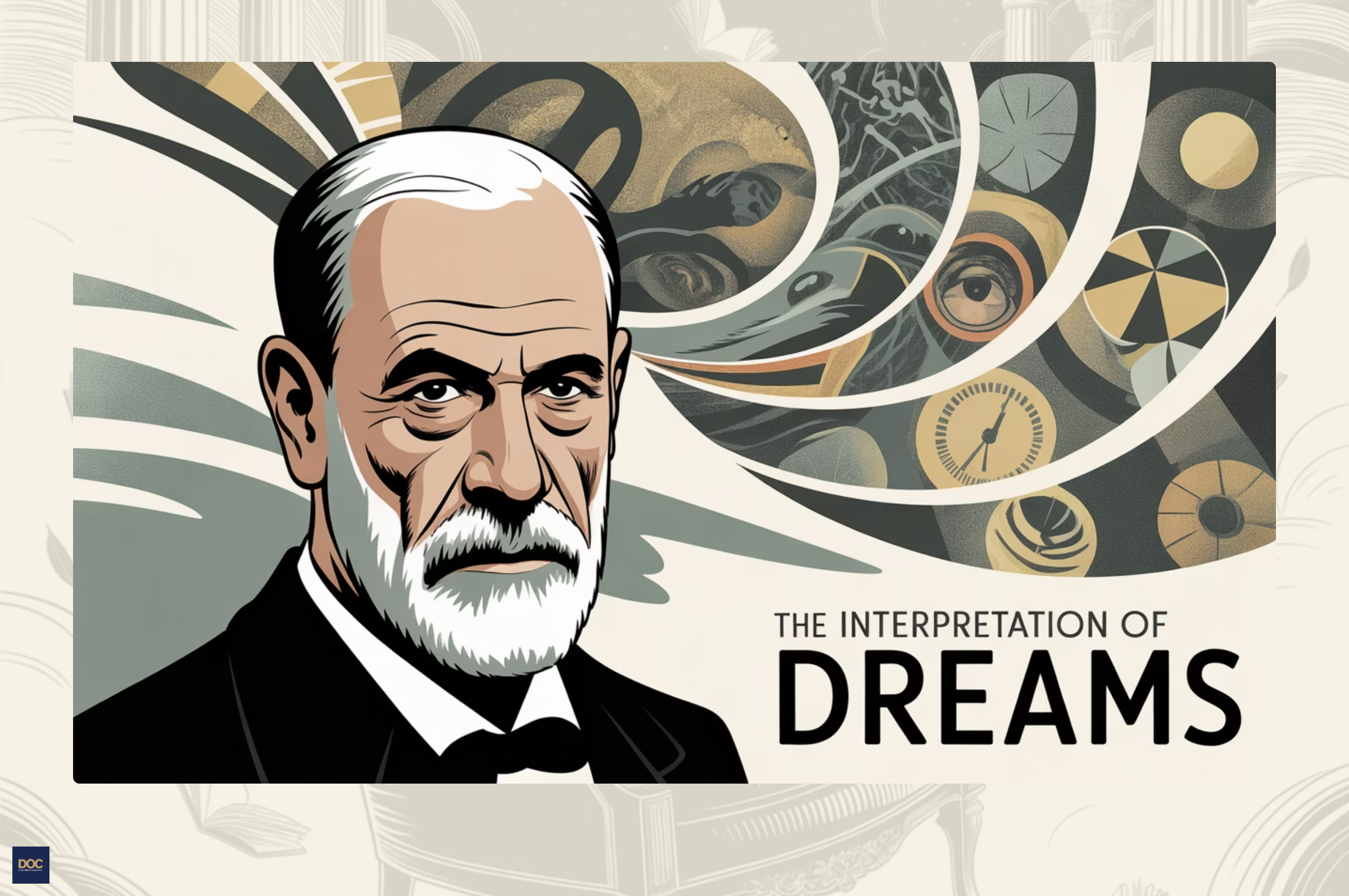
Over 120 years ago, a Viennese neurologist named Sigmund Freud dared to answer that question. In his monumental work, The Interpretation of Dreams, Freud didn't just offer a theory about dreams; he unveiled a radical new map of the human mind itself: the unconscious. This book would go on to reshape not only psychology, but also art, literature, film, and our very understanding of what it means to be human.
At our new online course, Decoding the Night: A Guided Reading of Freud's Interpretation of Dreams, we embark on a journey into this revolutionary text, providing you with the tools to understand Freud's audacious claims and, perhaps, even begin to decipher the mysteries of your own dreams.
The Audacious Claim: Every Dream is a Wish
Freud's core thesis is deceptively simple, yet profoundly challenging: every dream, without exception, is the fulfillment of a wish in disguise. But wait, you might ask, what about nightmares? How can a terrifying dream be a wish?
This is where Freud introduces his most crucial distinction: between the manifest content (the bizarre story we remember) and the latent content (the true, hidden meaning). Our minds, he argued, have an internal "censor" that prevents forbidden, often infantile, wishes from reaching consciousness directly. So, the dream-work—a series of clever psychological mechanisms—steps in to disguise these wishes, allowing them a hallucinatory fulfillment while simultaneously keeping them hidden.
Inside the Dream Factory: The Mechanics of Disguise
Imagine your mind as a master counterfeiter, taking a forbidden desire and transforming it into something unrecognizable yet deeply meaningful. Freud meticulously outlined these techniques of disguise:
Condensation: Your dream takes multiple ideas, people, or events and squashes them into a single, composite image. That person in your dream who looks like your boss, acts like your father, and says something your sibling once did? That's condensation at work.
Displacement: This is the censor's favorite trick. Intense emotion from a truly significant, often repressed, idea is shifted onto a seemingly trivial or innocent detail in the dream. The dream appears to be about a lost button, but the real anxiety is elsewhere entirely.
Representability: How does your mind turn abstract thoughts ("I feel trapped") into concrete images (a locked room)? Freud showed how dreams regress to a primitive, pictorial language, turning concepts into symbols.
Secondary Revision: This is your waking mind's attempt to make sense of the absurdity, stitching together fragmented dream images into a coherent (though often illogical) narrative, further obscuring the true meaning.
More Than Dreams: A Map of the Mind
Freud didn't stop at dream interpretation. He argued that these same mechanisms—condensation, displacement, repression—are at play in slips of the tongue, jokes, neurotic symptoms, and even works of art. Dreams became his "royal road" to understanding the entire architecture of the human psyche, divided into the conscious, preconscious, and the powerful, timeless unconscious.
Why Freud Still Matters (Even When He's "Wrong")
Today, neuroscience offers its own explanations for dreams, and many of Freud's theories have faced significant scientific and cultural critiques. So why bother with a book over a century old?
Because Freud gave us something invaluable: a new way of listening. He taught us a "hermeneutics of suspicion," compelling us to look beyond the surface, to question our conscious motives, and to seek deeper, hidden meanings in our own lives. He showed us that our past actively lives within us, shaping our present in ways we rarely acknowledge.
Whether you agree with every word or not, to read Freud is to fundamentally alter how you see yourself and the world. It's an invitation to explore the strange, rich landscape of your own inner life.
Are you ready to stop just having dreams and start decoding them?
Join us for "Decoding the Night: A Guided Reading of Freud's Interpretation of Dreams" and embark on a guided journey through one of the most influential books ever written.